What Are Fractals, And Why Should I Care?
Fractal geometry is a field of maths born in the 1970s and mainly
developed by Benoit Mandelbrot. If you’ve already heard of fractals,
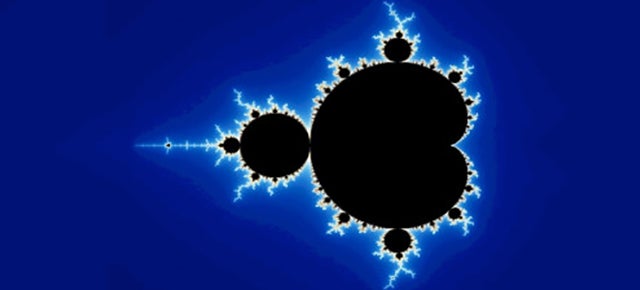
you’ve probably seen the picture above. It’s called the Mandelbrot Set
and is an example of a fractal shape.
The geometry that you learned in school was about how to make shapes;
fractal geometry is no different. While the shapes that you learned in
classical geometry were ‘smooth’, such as a circle or a triangle, the
shapes that come out of fractal geometry are ‘rough’ and infinitely
complex. However fractal geometry is still about making shapes,
measuring shapes and defining shapes, just like school.
There are two reasons why you should care about fractal geometry:
1. The process by which shapes are made in fractal geometry is
amazingly simple yet completely different to classical geometry. While
classical geometry uses formulas to define a shape, fractal geometry
uses
iteration. It therefore breaks away from giants
such as Pythagoras, Plato and Euclid and heads in another direction.
Classical geometry has enjoyed over 2000 years of scrutinisation,
Fractal geometry has enjoyed only 40.
2. The shapes that come out of fractal geometry
look like nature.
This is an amazing fact that is hard to ignore. As we all know, there
are no perfect circles in nature and no perfect squares. Not only that,
but when you look at trees or mountains or river systems they don’t
resemble any shapes one is used to in maths. However with simple
formulas iterated multiple times, fractal geometry can model these
natural phenomena with alarming accuracy. If you can use simple maths to
make things look like the world, you know you’re onto a winner. Fractal
geometry does this with ease.
This blog post shall give a quick overview of how to make fractal
shapes and show how these shapes can resemble nature. It shall then go
on to talk about dimensionality, which is a cool way to measure
fractals. It ends by discussing how fractal geometry is also beneficial
because randomness can be introduced into the structure of a fractal
shape. The post requires almost no maths and includes lot of pretty
pictures
How to make a fractal shape
In normal geometry shapes are defined by a set of rules and
definitions. For instance a triangle consists of three straight lines
that are connected. The rules are that if you have the length of all
three sides of the triangle it is completely defined, also if you have
the length of one side and two corresponding angles the triangle is also
defined. Though the rules defining a triangle are simple, huge amounts
of useful maths has come out of it, for instance Pythagoras’ Theorum,
sin() cos() and tan(), the proof that the shortest distance between two
points is a straight line, etc.
Fractal geometry also defines shapes by rules, however these rules
are different to the ones in classical geometry. In fractal geometry a
shape is made in two steps: first by making a rule about how to change a
certain (usually classically geometric) shape. This rule is then
applied to the shape again and again, until infinity. In maths when you
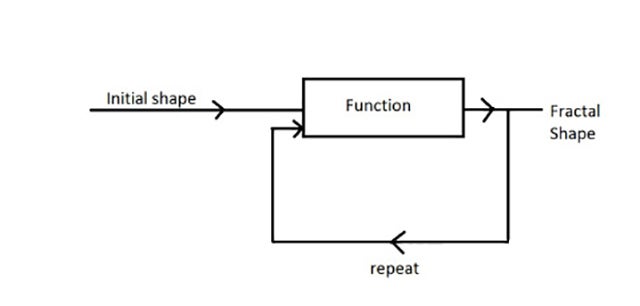
change something it is usually called a function, so what happens is
that a function is applied to a shape recursively, like the diagram
below.
After it has repeated an infinite amount of times, the fractal shape
is produced. What are these functions then? What do you mean by
repeating infinitely? As always, this is best explained by an example…
A good fractal shape is called the von Koch curve. The rules, or
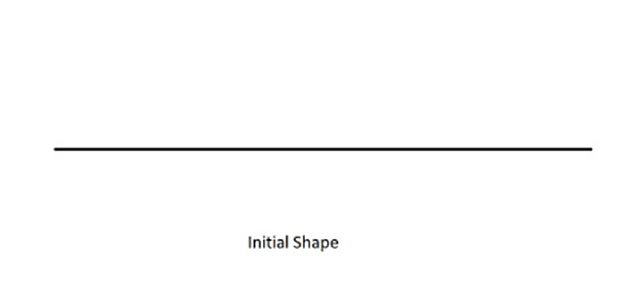
function, are extremely simple. First you start with a straight line.
This is your ‘initial shape’:
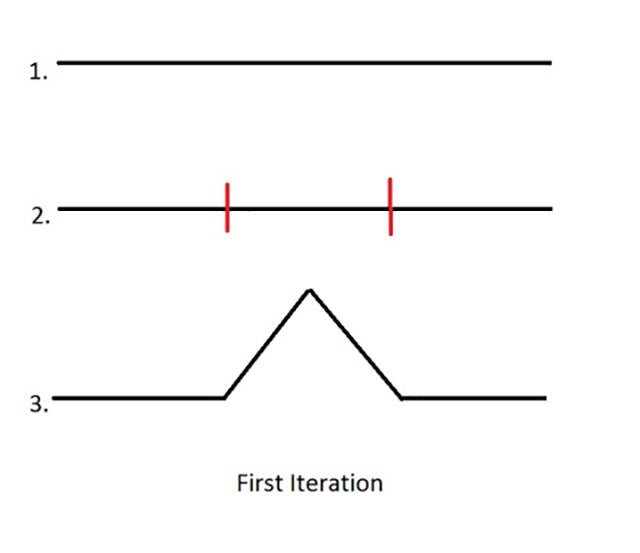
The rules are as follows:
1. Split every straight line into 3 equal segments.
2. Replace the middle segment with an equilateral triangle, and
remove the side of the triangle corresponding to the initial straight
line.
The process is shown in the figure below:
This is what happens to the straight line, our initial shape, when it
goes through the function the first time, the first iteration. Now, the
shape it has produced is fed back into the function again for a second
iteration:
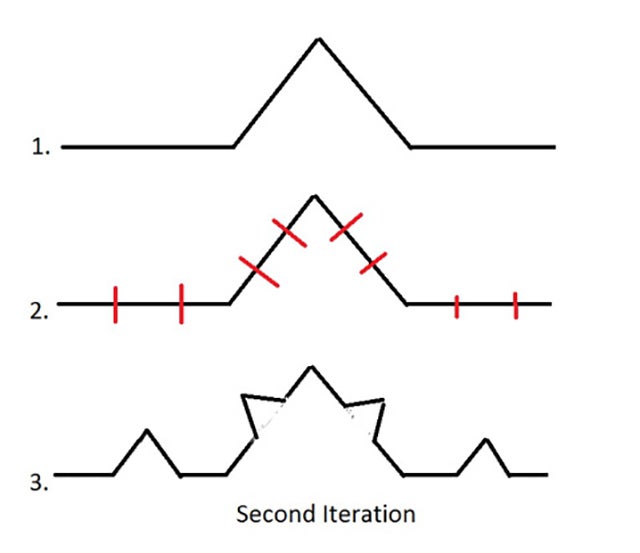
Remember the rule was that any straight line would be split into
thirds, so now 4 lines are split up and made into triangles. The shape
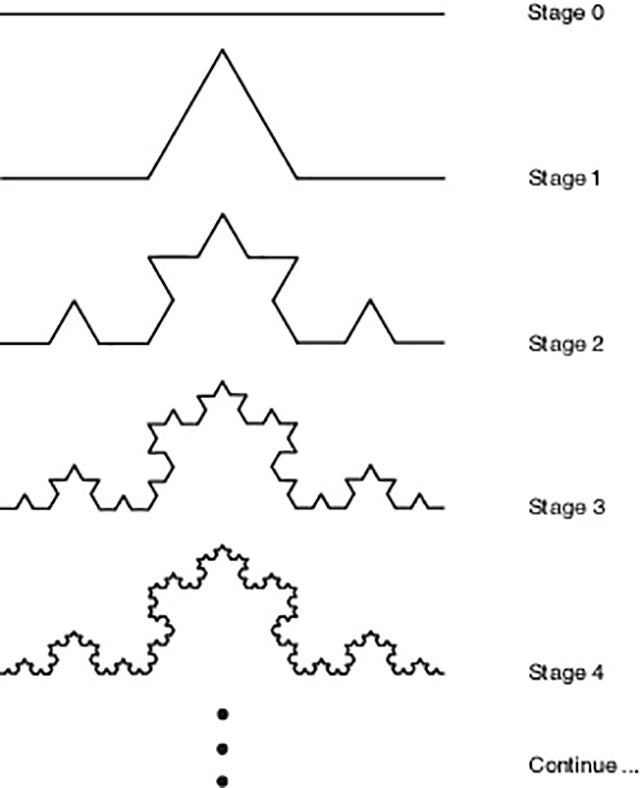
that is produced after the second iteration is then fed through the
function for a third time. This gets hard to draw in MS paint so I’ve
used a couple of pictures from
this website for the next few stages:
After this has iterated an infinite amount of times the fractal shape
is defined. This may sound bewildering but it is still possible to
analyse it mathematically and visually you can see what the shape starts
to look like. The GIF below (from Wikipedia) is a good illustration of
what the curve looks like by zooming in on it:
The von Koch curve is a great example of a fractal: the rule you
apply is simple, yet it results in such a complex shape. This kind of
shape is impossible to define using conventional maths, yet so easy to
define using fractal geometry.
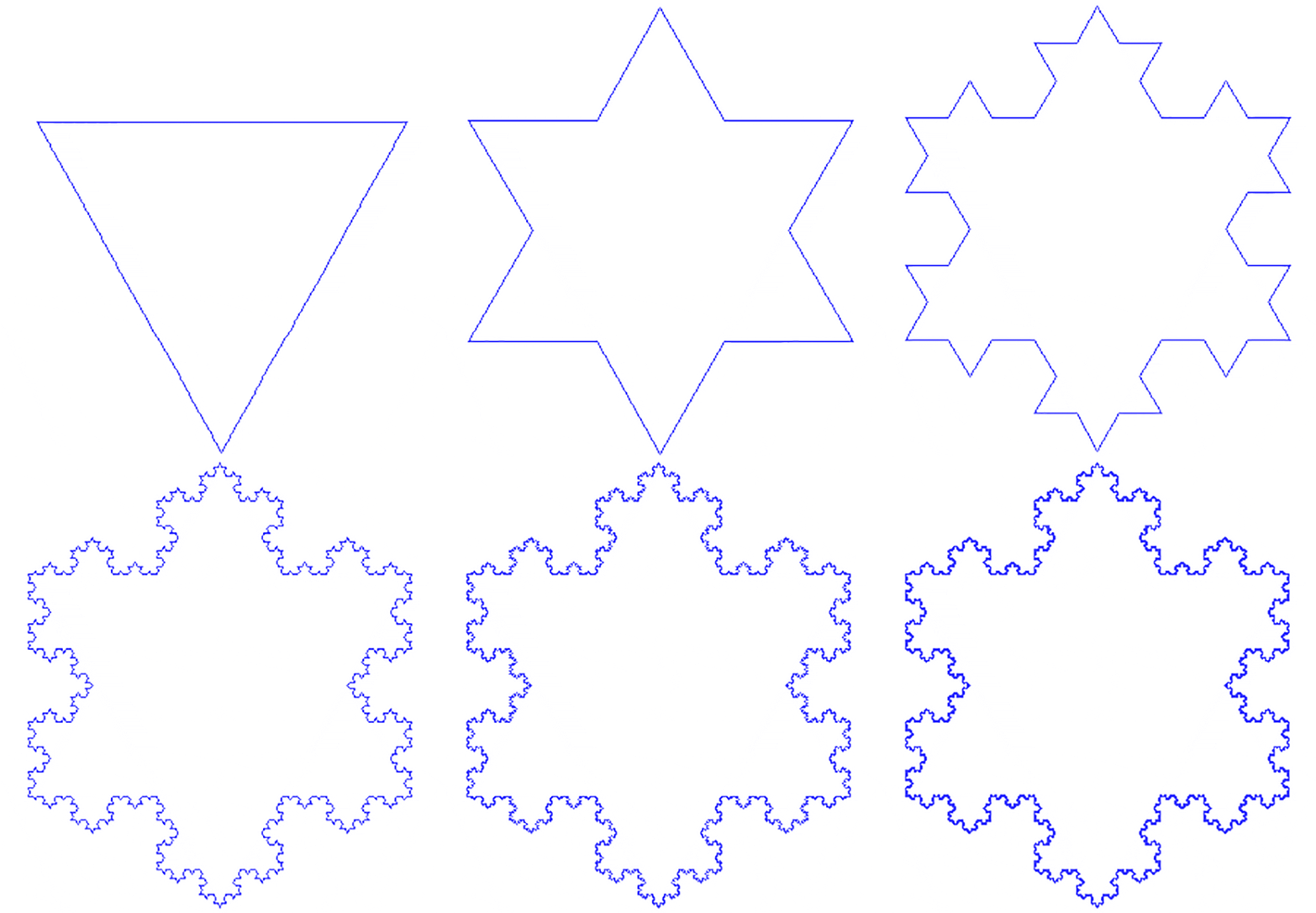
So who cares about the von Koch curve? Isn’t it just mathematicians
wasting time on weird shapes? I guess that depends on how you look at
it, but I’m convinced it’s useful because it looks exactly like a
snowflake. This is made more clear if the initial shape you start with
is a triangle rather than a straight line:
There’s a whole debate to be had on the purpose of maths, but as an
Engineer I am inclined to say that one of its purposes is to try and
replicate the world around us. The shapes that come out of fractal maths
are so different to conventional mathematical shapes and so similar to
the world around us that I cannot help but be seduced by this topic. Two
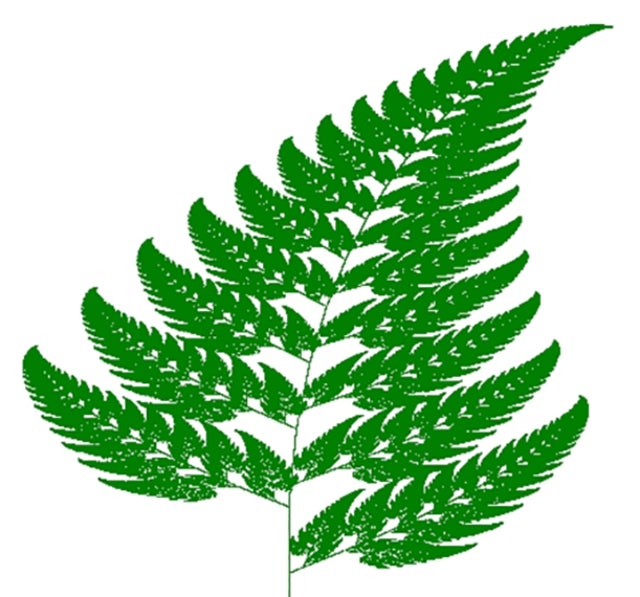
other shapes that are favourites of mine are the Barnsley Fern:
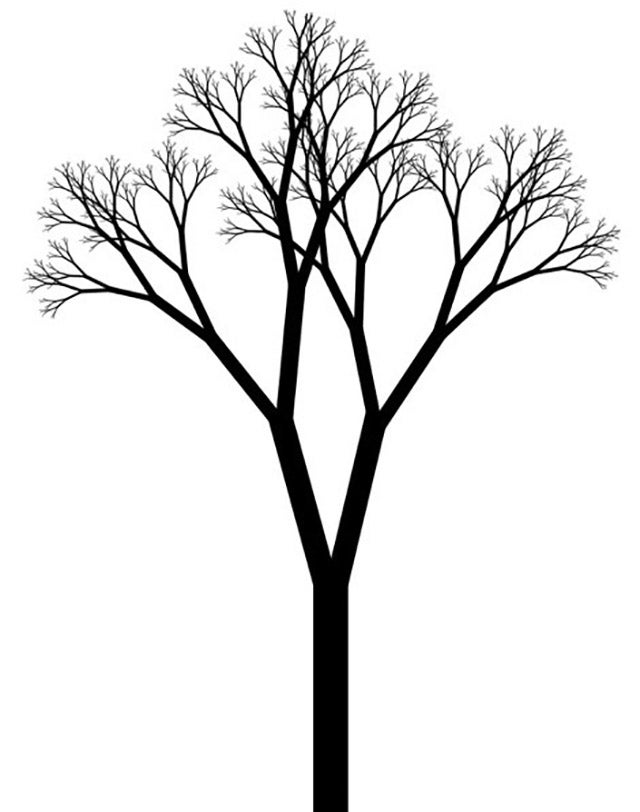
And fractal trees:
These aren’t drawings or pictures, but mathematical shapes. If you
look at the shapes you can see what function repeats itself. For
instance on the Barsley Fern the function is to draw 30 or so
perpendicular lines out of each straight line. The function repeats
itself to and looks like a fern. On the tree you can see that each line
branches out twice, which will be the function that repeats itself.
Another property about these shapes (though strictly not for all
fractals) is that they are
self-similar. This means
that the shape looks like itself however much you zoom in or out. For
instance on the tree above, if you snapped a branch off it and stood it
up, it would look like the original tree. If you took a twig from the
branch and stood it up, it would still look like the original tree.
Again, this is a property that occurs in nature, but until fractal
geometry there was not a good way to put it into maths.
Not only do these shapes look like natural objects, but the process
of iteration sounds intuitive when thinking about nature. When a tree is
growing, its trunk will create branches, these branches create further
branches, these branches create twigs. It’s as if the function is a
genetic code telling the branch how to grow and repeat itself,
eventually creating shapes that are ‘natural’. This may sound like
pseudo-science (it definitely is) but I think these are concepts worth
considering when you are able to imitate nature so closely.
Right enough about nature, time to talk about how fractals have crazy dimensions.
Dimensions
So now we know what fractal shapes are and how to make them, we would
like to know a few things about them. One of them first things to try
and figure out is the length of some of these shapes. Let’s go back to
the von Koch curve.
In order to figure out how long the full von Koch curve is (after
being iterated an infinite amount of times), it is useful to consider
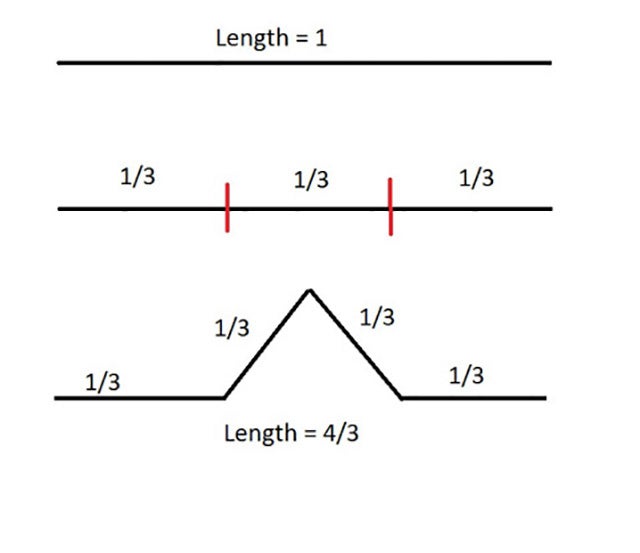
what happens at the first stage again:
The line is split into three, then the middle section is replaced by
two lines that are as long as it (as it’s an equal triangle). So if the
original straight line had a length of 1, the length of the curve after
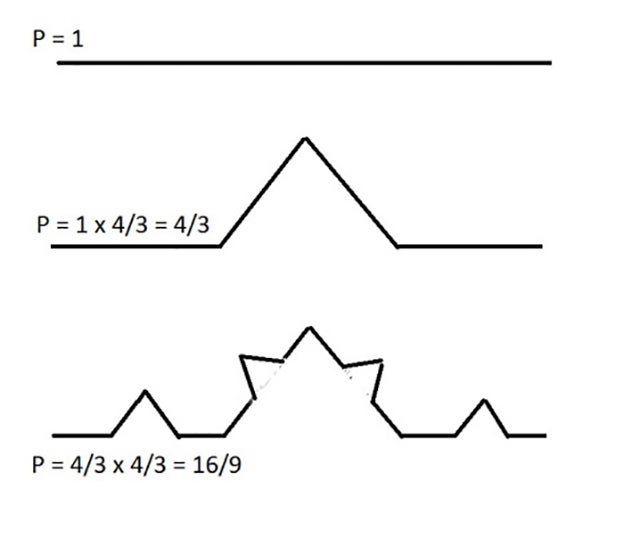
the first iteration is 4/3. It turns out that every time you iterate the
shape, it gets 4/3 longer. So the length of the curve after the second
iteration is 4/3 x 4/3 = 16/9:
As 4/3 is greater than 1, the line gets longer every time it is
iterated through the function. As you iterate the function an infinite
amount of times, the full von Koch curve has a perimeter that is
infinitely long! This is the case for all fractal shapes: they have
infinitely long perimeters. That isn’t useful for mathematicians so they
don’t measure the perimeter of the shape. Now the next few paragraphs
require a bit of abstract thought, but if you think a bit outside the
box it does make sense.
The perimeter measures the length around something. Length is a
one-dimensional measure of space. Length is 1D because it only measures a
straight line. A 2D measure of space is area, 3D is volume. Now we’ve
shown that it isn’t useful to measure fractal patterns in one-dimension
as they are infinitely long, but what is odd is that fractal shapes are
not 1D, 2D, or 3D. Each fractal shape has it’s own unique dimension,
which is usually a number with a decimal place.
The dimension of a fractal shape is a measure of how quickly the
shape becomes complicated when you are iterating it. What do we mean by
becoming complicated? Well in the von Koch curve you can see that the
first few iterations produce quite simple shapes, however at about
iteration 4 it starts to become quite small and complex.
The way to measure how fast a shape becomes complicated, and hence
its dimension, is to measure how much longer the perimeter gets after
each iteration. This makes sense intuitively, as if the line gets much
longer after each iteration it is probably becoming very complicated
very fast, whereas if the line stays pretty much the same length after
each iteration then it probably isn’t getting very complex.
As we’ve already shown, the von Koch curve gets 4/3 longer each
iteration. This means that the von Koch curve is 4/3 D, or 1.3333…D.
Pretty crazy right? It exists somewhere between 1D and 2D. But this
measure is really useful to mathematicians as it gives information about
the shape (whereas perimeter doesn’t, it’s always infinite). For
instance if there was another fractal shape which was 1.93D, you could
say with confidence that that shape gets complex quicker than the von
Koch curve, as the perimeter gets 1.93 times longer after each iteration
rather than 1.3333, implying it gets complex more quickly. When
studying a fractal shape, knowing its dimension is of integral
importance.
Randomness
The last thing I’m going to talk about is the fact that randomness
can be inserted into fractal shapes. Random (or seemingly random) events
occur in nature all the time and affect different things in a variety
of different ways, for instance a large part of Information Engineering
is dealing with noise, which randomly fluctuates an electronic signal.
When trying to replicate this, you usually add randomness on top of a
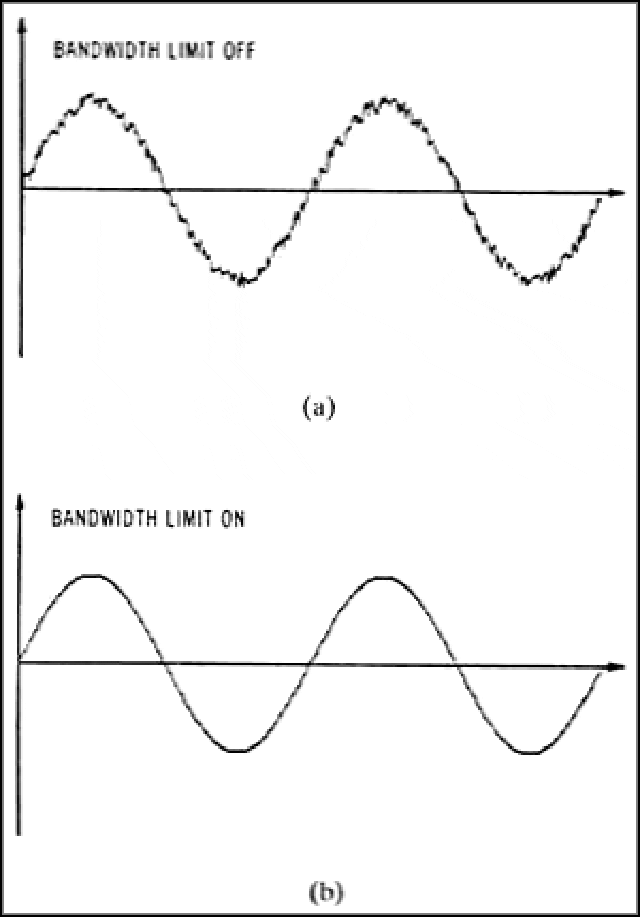
signal. For instance in electronics you would create a nice sine wave
and then add noise on top of it (borrowed from
this website):
The bottom image is the ‘pure’ wave, and the top image is the wave
with noise added on. An inherent assumption when doing this is that
there is an underlying ‘pure’ signal which is randomly altered. While
this may be true for a lot of electronics, the same cannot be said for
nature. Often there isn’t a ‘pure’ shape that is randomly altered around
the edges (for instance there are not many fuzzy squares in nature),
but rather randomness effects the structure of the shape itself at each
stage of its evolution. Classical geometry is not good at incorporating
randomness into shapes, whereas fractal geometry can do it easily. For
the last time lets turn to the von Koch curve. However this time we will
insert randomness into it.
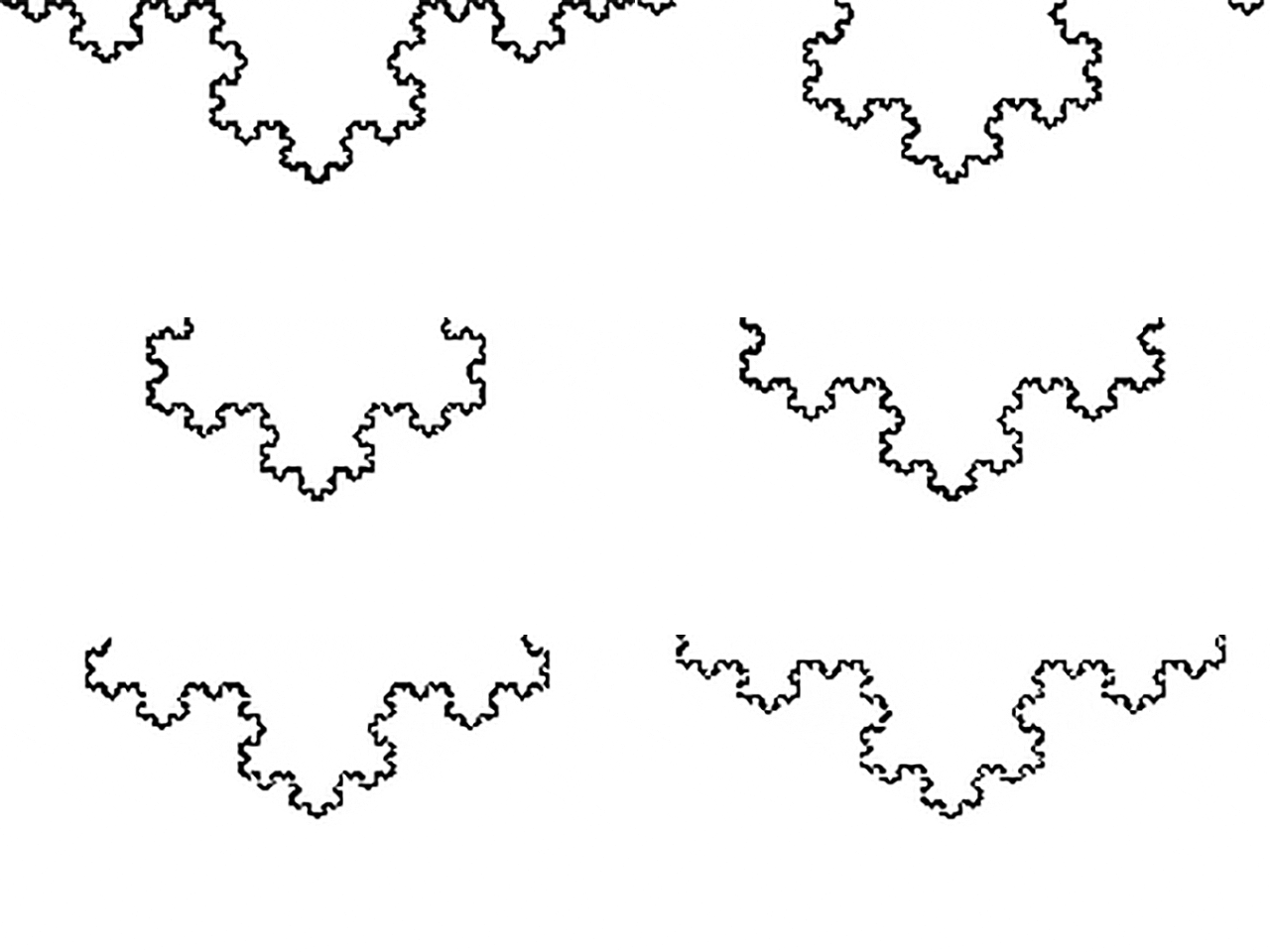
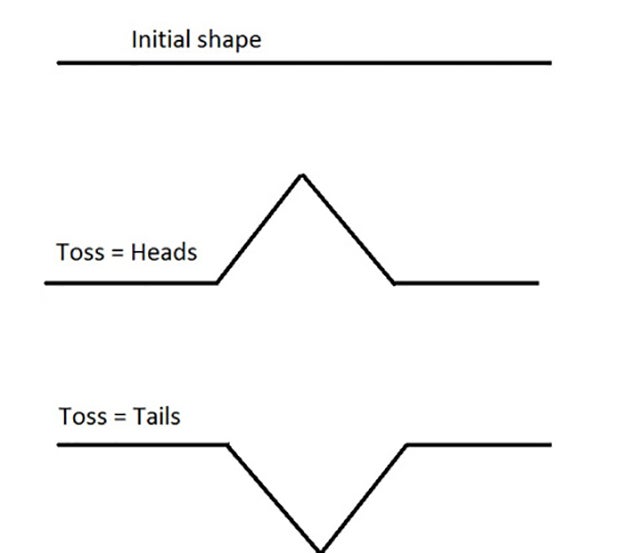
We know the rule is that for each iteration a triangle is created in
the middle third of a line. However every time the triangles always
faced “outwards”. We could insert randomness by saying that for each
triangle created, it goes either above the line or below the line
depending on a coin toss:
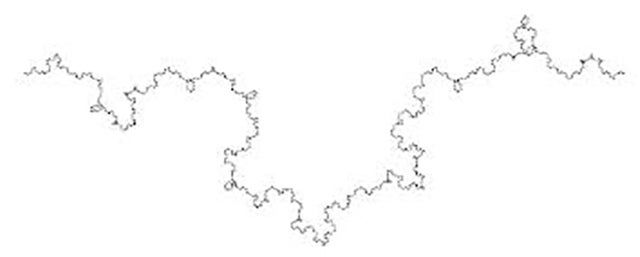
Now the shape will develop at random according to the coin toss. For
instance after multiple iterations the von Koch curve can look like
this:
Or it can look completely different. What is cool about this is that
you can insert randomness into the shape itself rather than adding it on
top of an existing shape. This has exciting potential, for instance
(going back to nature) this may be a good way to model random genetic
mutations.
This blog post has provided a brief introduction to fractal geometry. I hope you’ve found it interesting!




 ICEA as a concert hall? Who would’ve thunk?