Wednesday, July 30, 2014

Galaxy S4 Smartphone Burns Under Pillow

Girl’s Galaxy S4 Smartphone Burns Under Her Pillow as She Sleeps

Charging our devices as we sleep feels like a harmless routine. For one young Samsung smartphone owner, however, that habit almost turned heated. 
Last week, a 13-year-old North Texas girl plugged her Samsung Galaxy S4 in for its nightly juice-up before hitting the sack, only to be awoken by the smell of something burning hours later. When she got up and searched around for the source of the stench, she realized that she had wedged her charging phone under her pillow. And not only was the backside of the pillow scorched, but the phone was fried into an unrecognizable slab of plastic and melted components.
The event, according to FOX 4, left the family a bit surprised.
“We have a reasonable expectation that the products we buy are going to be safe,” the girl’s father said. He told FOX that he suspects that the phone overheated, causing the battery to swell and start a fire.
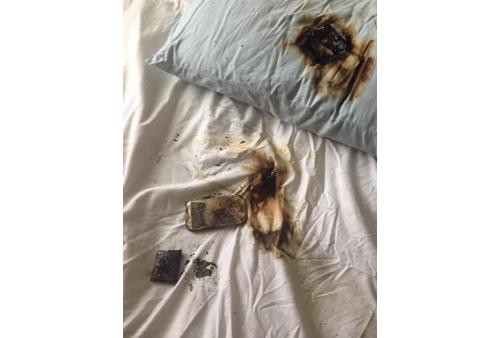
Girl’s Galaxy S4 Smartphone Burns Under Her Pillow as She Sleeps
(FOX 4)
The battery in the Galaxy phone was an aftermarket replacement, something a Samsung representative told FOX could have been part of the problem. The other issue, according to Samsung, was that the phone was being smothered by a pillow, restricting airflow while charging. This is something the manufacturer warns against in the device’s instruction materials.
Despite these miscues by the young Galaxy owner, Samsung told FOX and Yahoo Tech that the company will replace the phone, the pillow, and the mattress involved in the accident.
“Samsung takes product quality and customer safety very seriously,” a representative said.
“We have offered the customer a new device, and we are working to retrieve the product so that we can investigate what happened. We strongly advise all customers follow the guidelines of CTIA for care and handling wireless batteries. Additionally, our user manuals warn customers that phones must have adequate ventilation and airflow and should not be covered with material such as bedding.”
But our Texas family should hope for better service than the reddit user who recently posted a similar story has received. The owner alleges that his Galaxy S4 was also fried while charging, even though the charger and battery that came with it were in use. Now, despite being told by Samsung that the broken unit would be replaced, a month later, the redditor claims to be still waiting.

Tuesday, July 8, 2014

Remote control contraceptive

'Remote control' contraceptive chip available 'by 2018'

Chip from Microchips  
The chip would need replacing every 16 years (chip pictured is not the one described in the article)

A contraceptive computer chip that can be controlled by remote control has been developed in Massachusetts.
The chip is implanted under a woman's skin, releasing a small dose of levonorgestrel, a hormone.
This will happen every day for 16 years, but can be stopped at any time by using a wireless remote control.
The project has been backed by Bill Gates, and will be submitted for pre-clinical testing in the US next year - and possibly go on sale by 2018.
The device measures 20mm x 20mm x 7mm and will be "competitively priced", its creators said.
Convenience factor Tiny reservoirs of the hormone are stored on a 1.5cm-wide microchip within the device.
A small electric charge melts an ultra-thin seal around the levonorgestrel, releasing the 30 microgram dose into the body.
There are other types of contraceptive implant available, the researchers noted, but all require a trip to a clinic and an outpatient procedure in order to be deactivated.

“Start Quote

Someone across the room cannot re-programme your implant”
Dr Robert Farra
"The ability to turn the device on and off provides a certain convenience factor for those who are planning their family," said Dr Robert Farra from MIT.
The next challenge for the team is to ensure the absolute security of the device to prevent activation or deactivation by another person without the woman's knowledge.
"Communication with the implant has to occur at skin contact level distance," said Dr Farra.
"Someone across the room cannot re-programme your implant.
"Then we have secure encryption. That prevents someone from trying to interpret or intervene between the communications."
Huge range The same technology could be used to administer other drugs.
Simon Karger, head of the surgical and interventional business at Cambridge Consultants, said that implanted technology like this faces a range of challenges and risks.
But he added that overall "the value to the patient of these types of implant can be huge and we foresee a future in which a huge range of conditions are treated through smart implanted systems".
Pills Implanted devices could help people who forget to take medication at the correct time
The innovation comes at a time when governments and organisations around the world have agreed to try to bring family planning to around 120 million more women by 2020.
This challenge opens the door to this kind of implant technology being used in areas where access to traditional contraceptives is limited - a bigger priority, argued Gavin Corley, a biomedical engineer.
"That's a humanitarian application as opposed to satisfying a first-world need," he told the BBC.

Friday, June 6, 2014

OpenSSL bug allows hackers to see private communication

Newly discovered bug in OpenSSL could allow an attacker to see private communication
The world hasn't yet recovered from the Heartbleed vulnerability in OpenSSL and now there's news of a new bug affecting the popular open-source security package. This recently announced, and already patched, exploit could allow an attacker to see and modify traffic between an OpenSSL client and an OpenSSL server. This sounds worse than it really is. The extent of the issue is extremely limited because we're talking about specific versions of OpenSSL server. Plus, you need to be using that same server software on a client application, and the attack itself is quite a complicated affair.
The vulnerability, originally discovered in May by researcher Masashi Kikuchi, could allow for an attacker to lower the security of the communication between a client and a server using OpenSSL. In fact, this point is key: the package has to be present on both ends and then the attacker has to use what's known as a "man-in-the-middle" attack, something not necessarily easy to do. For the uninitiated, a man in the middle attack could be accomplished through a bit of compromised hardware -- like, say a router in your local coffee shop -- that strips the encryption from the information.
The bug affects all client versions of OpenSSL and servers on version 1.0.1 or 1.0.2-beta1, though it is recommended to update earlier versions as a precaution. The biggest problem is that we don't really know how many of our applications are using this security package, as this information is not normally disclosed. That said, Adam Langley, a security engineer from Google, confirmed that desktop browsers such as "IE, Firefox, Chrome on Desktop and iOS, Safari, etc." are not vulnerable, as they don't use OpenSSL.
The problem is serious if all the required variables are in place, but you shouldn't worry about it too much. That is, if you're not a systems administrator. And you shouldn't even worry about using software with OpenSSL in general. You may be surprised to hear this after the Heartbleed issue and this new problem, but the fact is that this latest exploit was discovered because there are more eyes reviewing the OpenSSL code, which means that the software is getting even better and safer.

Monday, June 2, 2014

iOS 8 is official

iOS 8 is official

Apple took the wraps off iOS 8 during today’s WWDC keynote. The latest OS release brings a host of new features and improvements, headed by the ability to closely interact with the freshly announced OS X Yosemite.

The features which allow iOS 8 to interact with OS X Yosemite is dubbed Handoff. An expansion of AirDrop, the functionality allows iOS 8 devices to share a multitude of tasks and data with OS X Yosemite, including phone calls messages, files, etc.
The Apple WWDC 2014 keynote is still under way so check back for updates.

Tuesday, May 27, 2014

Paralyzed teen to kick World Cup's first ball, mind-controlled exoskeleton

Paralyzed teen to kick World Cup's first ball with mind-controlled exoskeleton

This year's World Cup could be host to something more exciting than a bicycle kick scoring the winning goal. Thanks to an international collaboration between universities such as Colorado State University, the Technical University of Munich and the Lily Safra International Institute of Neuroscience of Natal in Brazil, a paralyzed teen is set to open the sporting event by kicking a football while wearing a motorized exoskeleton controlled by his or her brain. Colorado State University in particular recently published a video of its portion of the Walk Again Project, describing just how the mind-control helmet was 3D-printed layer-by-layer in order to fit the wearer's head and connect the electrodes. Take a peek after the break to see the video in question, which also offers a fascinating look into how advances in robotics and 3D printing can improve people's lives. Which is a hell of a lot more entertaining than watching Nigel de Jong roughing up Xabi Alonso again

Samsung smartwatch concept can be controlled by waving your hands

Samsung smartwatch patent with touchless gestures

Touchscreens on smartwatches are limited by their very nature; there's only so much you can fit on a tiny piece of glass. However, Samsung might overcome that surface area limit if it ever implements a recently published patent application. Its smartwatch concept would let you perform relatively complex tasks just by waving your hands in front of a built-in camera. You could send content to a TV just by flicking your hand, for example, or select something by pointing your finger.
That wouldn't be the only party trick. The watch would recognize wrist gestures beyond the simple screen activation you find in Samsung's Gear line, for a start. It would also have a Moto 360-style circular display with both an optimized touchscreen interface and a rotating ring for tasks like scrolling. It's an ambitious, do-it-all design, and it won't be surprising if Samsung only uses some of the technology -- if it's used at all. When Samsung is already big on gesture control and plans to support Android Wear, though, there's a real chance that future smartwatches will let you do much more than poke at buttons and issue simple voice commands.

China bans Windows 8 to open doors for domestic OS

Windows 8 ban may open door for China's domestic OS

With Windows 8 now banned from being installed on Chinese government computers, domestic operating system (OS) developers are itching for a niche in the world's biggest PC market.
The country's relatively large OS developers, including China Standard Software Co. and NFS China among others, have fresh opportunities, but their products face long and tough tests.
Windows 8 was banned from all desktops, laptops and tablet PCs purchased by central state organs last week. The announcement made by the Central Government Procurement Center did not make clear whether other Windows products were prohibited as well.
China's ambitious OS makers, that are developing products based on Linux, took immediate action in response to the government ban.
"There are differences between Windows and Linux, but we are trying to make consumers feel almost the same when using our products," said China Standard Software Co. in a statement.
The company is a joint venture of China Electronics Corporation and China Electronic Technology Group Corporation, two state-owned enterprises.
China Standard Software Co. said its Neokylin Linux OS is "a safe and controlled product that meets the security demands for government, defense and other confidential fields".
Another OS maker NFS China, which is affiliated with the Software Research Institute of the Chinese Academy of Sciences, is also actively marketing its products featuring "high security and special design for Chinese consumers".
"Domestic OS can support basic functions like processing texts and pictures, playing music and videos and providing Internet services, although the user experience is not as good as Windows," said Ding Liping, a researcher with the institute.
One of the advantages that China's OS makers have is that their products usually have open source code, which allows programmers to design any software they need, according to China Standard Software Co.
The country's rapidly expanding tablet PC and smart television market also creates room for domestic OS makers as most of these devices run Linux-based Android OS, said Yang Yilong, vice CEO of IT company Knownsec.
In fact, it is not uncommon for the country's self-developed softwares, which are created in accordance with Chinese people's habits, to beat foreign rivals.
Tencents's messaging software QQ proves to be more popular than Microsoft's MSN. Baidu does better than Google in searching in Chinese language. Kingsoft's WPS wins a large user base against Microsoft's Office. More importantly, most of the domestic softwares are free or much cheaper and very easy to download.
However, previous failures showed that success in the business is not that easy as development of an OS entails money and time.
Red Flag Software Technology Co., one of China's most promising OS makers, went bankrupt in February partly because of a snapped money chain as its products were not well received.
Tan Xiaosheng, a senior manager in charge of privacy with IT company Qihu 360, said whether domestic OS developers can make a difference relies on the opening up of the market.
"Many of China's IT giants have enough money to conduct OS business. What they expect is preferential policies," said Tan, adding that failures may recur if the country's OS market is dominated only by a few state-owned companies.
A Ministry of Industry and Information Technology spokesman signaled last month that the ministry would strengthen support for the development and application of Linux OS.
But a detailed plan is yet to be revealed.

SECURITY CONCERNS
Although there is no official explanation of why Windows 8 was excluded, analysts believe that security issues may be the major concern.
Windows 8 boasts built-in Windows Defender and Windows SmartScreen that "can help guard your PC against viruses, spyware, and other malicious software in real time".
This means that users risk being monitored and national security is at danger when it is installed on government computers, said Ni Guangnan, an academician with the Chinese Academy of Sciences.